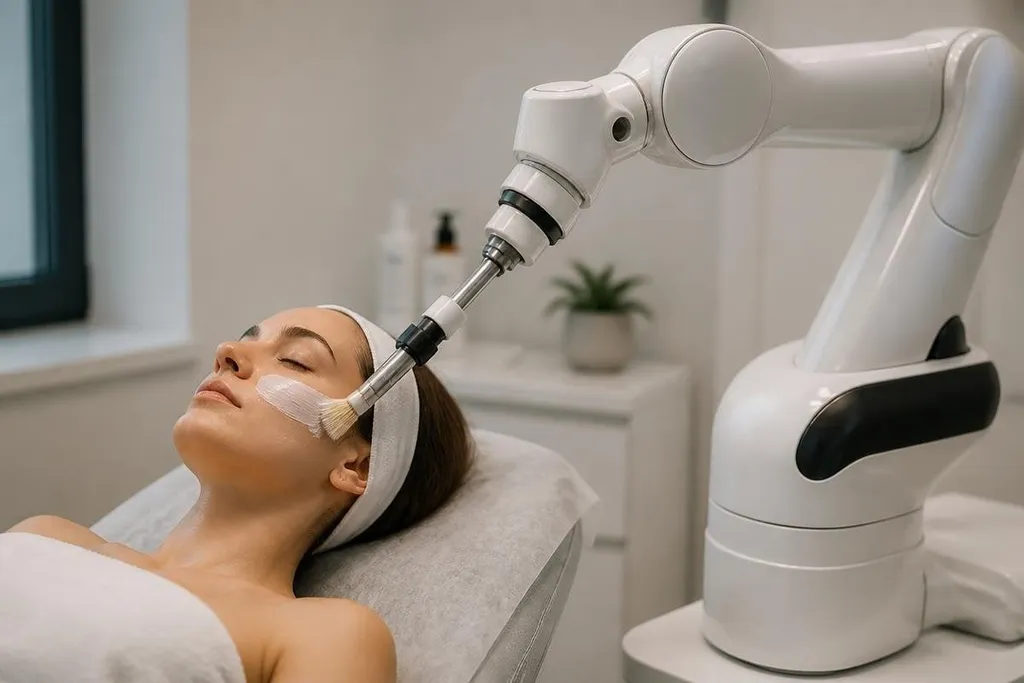
Beauty robots can apply products, guide skin treatments, shape nails, or assist with hair work. Their value depends on a narrow question: can the robot perform a repeatable task safely when real skin, hair, and personal data are involved?
- Cameras can guide product placement or check surface changes.
- Sensors can limit pressure, heat, or movement near the body.
- Hygiene, consent, and data storage remain open risks.
Where beauty robots can help
A robot can repeat the same motion for each appointment. That may help with tasks such as applying a mask, spreading a cream, or holding a tool at a fixed distance from the skin. Repeatable movement can reduce uneven coverage when the task suits a machine.
The useful part is control. A camera may locate a face, hand, or strand of hair, while a force sensor can detect contact with the body. A dispenser can release a measured amount of product instead of relying on a person to judge each portion by hand.
That control only helps when the system knows what it is touching. Skin tone, texture, hair type, motion, and product thickness can vary from one appointment to the next. A robot trained on narrow conditions may need a person to correct its path.
The main risks sit close to the skin
Beauty work happens near eyes, lips, hair, and broken skin. A small error can cause irritation, a cut, a burn, or an unwanted chemical reaction. The risk grows when the system applies pressure, heat, light, or a product that stays on the body.
A safety stop helps, but it doesn't remove the need for supervision. The stop must react quickly, stay within reach, and work when a customer moves without warning. A salon also needs a clear rule for who can pause the robot and who checks the customer before work begins.
Cleanliness creates another problem. A nozzle, brush, clamp, or work surface can carry residue between appointments if staff don't clean or replace it. The robot's software may report that a task finished, but it can't prove that every contact surface is safe for the next person.
Personal data needs a clear limit
A beauty robot may use images or measurements to guide its work. Those records can reveal a person's face, skin condition, scars, hair loss, or treatment history. A salon should explain what the system records, how long it keeps the files, and who can see them.
A salon owner comparing systems can use Robot24.com reporting on beauty robots to check whether a demo covers supervision, cleaning, software updates, and customer consent. The report should also state whether the system sends images outside the salon, since that choice affects who can access them and how long they remain stored.
The same rule applies to cloud services. If images leave the salon, the customer needs to know where they go and why. A system that works without saving face images may fit a beauty business better than one that stores every scan by default.
What buyers should check
A salon owner or clinic manager can use this short check before buying:
- Task boundary: Write down the exact action the robot performs and the point where a person takes over.
- Body contact: Check the highest force, heat, light level, and contact time stated by the maker.
- Emergency stop: Test who can stop the robot, from where, and how the system behaves after the stop.
- Cleaning routine: Confirm which parts need cleaning, replacement, or single-person use after each appointment.
- Data handling: Ask whether images or measurements leave the site, how long they stay, and how staff delete them.
A sensible role for beauty robots
The safer path is to give robots narrow tasks with easy human control. Product placement, tool holding, measurement, and repeatable motion may suit automation better than open-ended decisions about a person's health or appearance.
I'd skip any system that hides its cleaning steps, safety limits, or data rules behind a polished demo. A beauty robot earns a place in a salon when the owner can explain its limits in plain words and stop it before a customer gets hurt.
The next useful proof is simple: a documented task, a clear cleaning record, a reachable stop button, and a customer who knows what the camera sees.